
AI Fraud Detection in Banking: Why It Fails and How to Fix It

AI promises real-time fraud detection, but many banks still struggle with false positives and ineffective systems. The issue isn’t the technology—it’s how it’s implemented. This article breaks down the core requirements, common failures, and proven steps to make AI work in your bank.
What AI Fraud Detection Actually Does
AI fraud detection in banking uses machine learning to analyze transaction data, behavioral signals, and network patterns in real time. It’s not a magic box—it’s a system that scores every transaction against known fraud patterns and flags anomalies for review. The goal is to reduce false negatives (missed fraud) and false positives (blocked legitimate transactions), but most implementations fail at one or both.
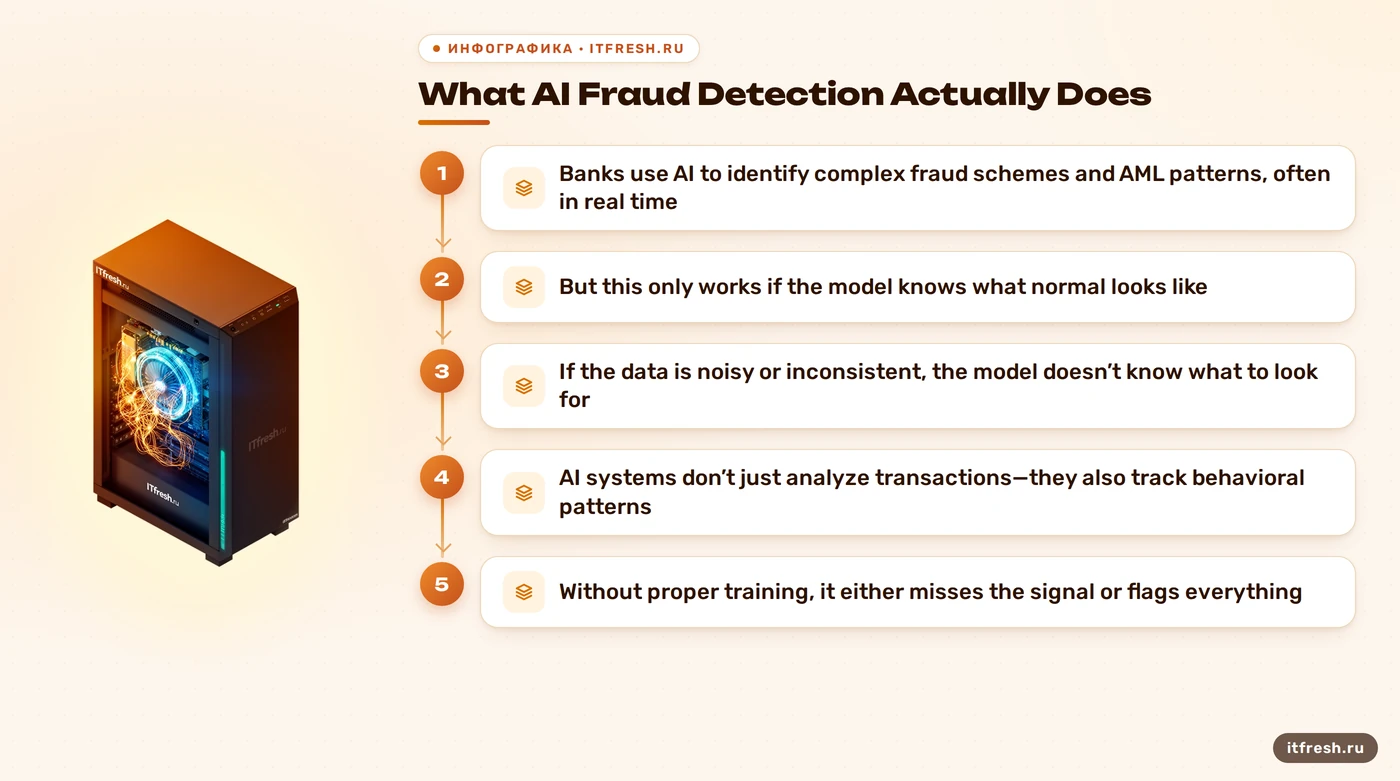
Banks use AI to identify complex fraud schemes and AML patterns, often in real time. The systems process millions of transactions, applying models trained on historical data to detect deviations. But if the training data is flawed or the model isn’t updated, the system becomes a liability. Even with 93 of the 120 largest US banks using AI for fraud detection, many still rely on outdated rules engines or poorly tuned models.
The technology isn’t new—AI has been used in insurance fraud prevention for years, and the principles apply to banking. It’s about pattern recognition: identifying when a transaction deviates from a user’s typical behavior, such as a sudden large transfer to an unfamiliar account. But this only works if the model knows what normal looks like. If the data is noisy or inconsistent, the model doesn’t know what to look for.
AI systems don’t just analyze transactions—they also track behavioral patterns. For example, a user who normally logs in from Moscow at 9 AM might suddenly log in from a different country at 3 AM. The system flags this as suspicious, but only if the model has been trained on enough data to recognize the pattern. Without proper training, it either misses the signal or flags everything.
In practice, AI fraud detection involves multiple steps: data ingestion, feature engineering, model scoring, and alert routing. Each step must be reliable. If the data pipeline is slow, the model runs late. If the features are poorly defined, the model misclassifies. If the alert system is broken, the bank never acts. The system is only as strong as its weakest link.
The Hidden Cost of Poor Data Quality
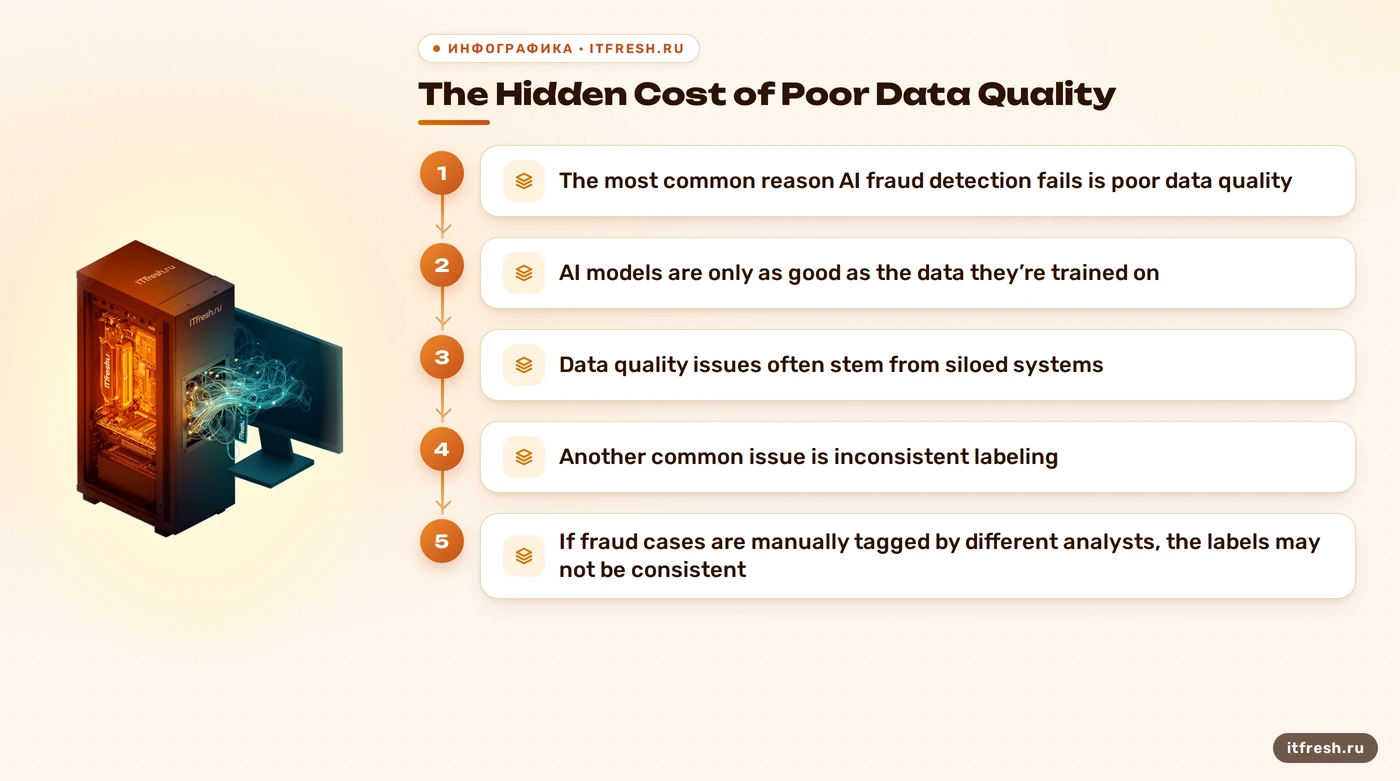
The most common reason AI fraud detection fails is poor data quality. AI models are only as good as the data they’re trained on. If transaction logs are inconsistent, missing fields, or contain errors, the model will learn the wrong patterns. For example, if a bank’s system logs only successful transactions and ignores failed attempts, the model will not recognize the full scope of fraud behavior.
Data quality issues often stem from siloed systems. A bank may have separate databases for credit cards, loans, and online banking, each with different formats and update cycles. When AI systems pull from these sources, the mismatched data creates noise, leading to inaccurate scoring. In practice, poor data quality can reduce AI accuracy by up to 40 %—a figure that’s not hypothetical but well-documented in real-world deployments.
Another common issue is inconsistent labeling. If fraud cases are manually tagged by different analysts, the labels may not be consistent. One analyst might label a transaction as fraud because the amount is high, another because the location is unusual. This creates ambiguity in the training data, making it harder for the model to learn the correct patterns.
Poor data quality also leads to model drift. If the model is trained on old data that no longer reflects current behavior, it will make incorrect predictions. For example, if a model is trained on pre-pandemic spending habits, it might flag a user’s new remote-work spending as suspicious. The model needs to be retrained regularly to adapt to changing patterns.
Fixing data quality is not optional—it’s the foundation. Banks must standardize data formats, validate inputs, and ensure completeness. Data pipelines should be monitored for integrity, with automated checks to catch missing or corrupted records before they reach the model. Without this, no amount of AI sophistication will help.
Real-Time Scoring and Actionable Alerts
AI fraud detection isn’t just about identifying anomalies—it’s about enabling real-time responses. Systems must score each transaction instantly and route suspicious activity to appropriate actions, such as blocking, user verification, or manual review. Delayed responses defeat the purpose, especially in high-volume environments.
The process involves multiple layers: data ingestion, feature engineering, model scoring, and alert routing. If any step is slow or broken, the entire system fails. For instance, if the model runs hourly instead of in real time, it misses fast-moving fraud. Even small latency increases can allow fraudsters to exploit gaps before the system reacts.
Real-time scoring requires robust infrastructure. The model must be deployed in a low-latency environment, with fast access to transaction data. If the model runs on a slow server or in a poorly optimized cloud environment, the response time will suffer. This is why AI fraud detection often requires dedicated hardware or high-performance cloud instances.
Alerts must be actionable. A system that flags 10,000 transactions as suspicious but sends them to a single analyst is useless. The alerts must be prioritized, with high-risk cases flagged for immediate attention. This requires integrating the AI system with a case management platform, so analysts can review, investigate, and close cases efficiently.
Even with real-time scoring, false positives remain a problem. A model that flags 10 % of transactions as suspicious will generate 10,000 alerts per day in a high-volume bank. If 9,500 of those are false, the analysts will be overwhelmed. The system must be tuned to minimize false positives while maintaining high detection rates.
Common Pitfalls in AI Fraud Systems
One of the biggest pitfalls is over-reliance on AI without human oversight. AI models can generate false positives—legitimate transactions flagged as fraudulent—especially when trained on imbalanced data. If a bank’s fraud rate is 0.1 %, the model may be trained on 99.9 % non-fraud examples, causing it to overfit to normal behavior and miss subtle fraud patterns.
Another issue is model drift. As customer behavior evolves, so do fraud tactics. If the model isn’t retrained regularly, it becomes outdated. For example, a model trained on 2020 data may not recognize new mobile payment fraud schemes. Without continuous monitoring and retraining, AI systems degrade over time, leading to increased false negatives and operational friction.
Many banks also fail to monitor the system’s performance. They deploy a model, assume it works, and never check how well it’s doing. But AI systems need ongoing evaluation. Metrics like precision, recall, and F1-score should be tracked monthly. If recall drops, it means the model is missing more fraud. If precision drops, it means more false positives. Both are red flags.
Another common mistake is not using feedback loops. When analysts review flagged transactions, the results should be fed back into the model. If a flagged transaction is confirmed as legitimate, the model should learn that this pattern is not fraud. Without this feedback, the model can’t improve. It’s like training a dog without rewards or corrections.
Finally, many banks don’t consider the cost of false positives. Blocking legitimate transactions hurts customer experience and can lead to lost business. If a model blocks 1 % of transactions, and 90 % of those are false, the bank is losing 0.9 % of its revenue to unnecessary friction. This is not just a technical issue—it’s a business one.
Best Practices for Effective AI Fraud Detection
To make AI fraud detection effective, banks must prioritize data governance. This includes standardizing data formats, ensuring completeness, and validating inputs. Data pipelines should be monitored for integrity, with automated checks to catch missing or corrupted records before they reach the model.
Additionally, AI systems should be integrated with human review processes. High-risk transactions should be flagged for manual review, not automatically blocked. This hybrid approach reduces false positives while maintaining security. Banks should also implement feedback loops, where flagged transactions are reviewed and the results used to retrain the model. This ensures the system learns from real-world outcomes.
Model training should be done on balanced datasets. If fraud is rare, the model should be trained on a representative sample, not just the majority class. Techniques like oversampling or synthetic data generation can help. The model should also be tested on real-world data to ensure it performs well in production.
AI systems must be monitored continuously. Metrics like precision, recall, and F1-score should be tracked monthly. Alerts should be sent if performance drops below a threshold. This allows the team to respond quickly if the model starts to degrade. Without monitoring, the system becomes a black box.
Finally, banks should consider using ensemble models. Instead of relying on a single AI model, they can combine multiple models—each trained on different data or using different algorithms. This improves overall accuracy and reduces the risk of a single point of failure.
How to Check if Your AI System Is Working
The only way to know if your AI fraud detection system is working is to measure it. Key metrics include precision, recall, and F1-score. Precision measures the percentage of flagged transactions that are actually fraudulent. Recall measures the percentage of actual fraud that is detected. F1-score balances the two.
Banks should also track false positive and false negative rates. A high false positive rate means too many legitimate transactions are being blocked. A high false negative rate means too much fraud is slipping through. Both are costly—false positives hurt customer experience, false negatives cost money.
Performance should be monitored monthly. If the model’s precision drops, it means the model is generating more false positives. If recall drops, it means it’s missing more fraud. Either issue requires investigation. Was the data quality worse? Did the model drift? Was there a change in fraud tactics?
Another metric is the number of manual reviews per day. If the system generates 10,000 alerts but only 100 are reviewed, the system is overwhelmed. If it generates 1,000 alerts and 500 are reviewed, it’s more manageable. The goal is to reduce the number of alerts while maintaining high detection rates.
Banks should also conduct regular audits. This includes reviewing a sample of flagged transactions to see if the model is making correct decisions. Audits should be done quarterly, with results used to retrain the model. Without audits, the system becomes a black box.
What to Do If Your System Is Already Broken
If your AI fraud detection system is already failing—generating too many false positives or missing too much fraud—the first step is to stop and assess. Don’t just retrain the model and hope it gets better. That’s like giving a car a new paint job when the engine is broken.
Start by auditing the data. Check for inconsistencies, missing fields, and labeling errors. If the data is flawed, no amount of AI will fix it. Fix the data first, then retrain the model. This is not optional—it’s the only way to get accurate results.
Next, review the model’s performance. Check precision, recall, and F1-score. If precision is low, the model is generating too many false positives. If recall is low, it’s missing too much fraud. Use this data to determine where the system is failing.
Then, check the feedback loop. Are analysts reviewing flagged transactions and feeding the results back into the model? If not, the model can’t learn. Implement a process where every flagged transaction is reviewed, and the results are used to retrain the model.
Finally, consider bringing in experts. If your team doesn’t have the skills to fix the system, don’t try to do it alone. We’ve seen banks waste months trying to fix AI systems without the right expertise. The cost of failure is high—fraud losses, customer complaints, and regulatory scrutiny.
The Bottom Line: AI Is Not a Silver Bullet
AI can be a powerful tool in fraud detection, but it’s not a silver bullet. It requires high-quality data, continuous monitoring, and human oversight. Without these, AI systems will fail, leading to false positives, missed fraud, and operational chaos.
Banks must treat AI fraud detection as a system, not a product. It requires ongoing effort—data governance, model retraining, performance monitoring, and feedback loops. If any of these are missing, the system will degrade over time.
The most common mistake is assuming AI works out of the box. It doesn’t. It needs to be built, tested, and maintained. Even the best AI model will fail if the data is poor or the team doesn’t monitor it.
In practice, AI fraud detection is only effective when integrated with strong processes and skilled staff. The model is just one part of the system. The rest—data, monitoring, human review—matters just as much.
If you’re still relying on rule-based systems or outdated AI models, it’s time to reconsider. The technology is available. The cost of inaction is too high.
Частые вопросы
How does AI contribute to fraud detection in banking?
AI enhances fraud detection by analyzing transactional data in real time to identify suspicious patterns. It uses machine learning to process large datasets and flag anomalies, enabling faster and more accurate responses than traditional rule-based systems.
What are the main challenges in AI fraud detection?
The main challenges include poor data quality, model drift, false positives, and lack of human oversight. AI systems can generate inaccurate results if trained on flawed data or not updated regularly.
Can AI reduce false positives in fraud detection?
Yes, when properly implemented. AI can reduce false positives by learning from historical data and feedback loops, but only if the model is trained on high-quality data and continuously monitored.
Why is data quality critical for AI fraud detection?
Poor data quality can significantly reduce AI accuracy. If the training data contains errors, missing fields, or inconsistencies, the model will learn incorrect patterns, leading to unreliable detection.
How often should AI fraud models be retrained?
Models should be retrained regularly—ideally monthly or quarterly—especially when customer behavior or fraud tactics change. Without retraining, models degrade over time, leading to increased false negatives and positives.
What is the role of human analysts in AI fraud detection?
Human analysts are essential for reviewing flagged transactions, providing feedback to the model, and making final decisions. AI can’t interpret context or handle edge cases—only humans can.
Источники
- IBM — AI fraud detection in banking uses machine learning to analyze transaction data, behavioral signals, and network patterns in real time.
- Backbase — AI fraud detection tools use machine learning to identify fraudulent transactions in real-time.
- Inaza — Poor data quality can reduce AI accuracy in fraud detection.
- Bosfera — AI systems in banks face risks of false positives and model drift.
- BankingNewsAI — 93 of the 120 largest US banks use AI for fraud detection.
- Avenga — AI improves real-time fraud detection by identifying anomalies in transaction data.